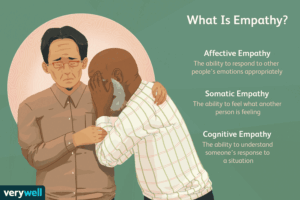


Empathetic listening is the practice of fully understanding and validating another person’s emotional experience without judgment, interruption, or immediate attempts to solve their problems. Unlike simply hearing words, empathetic listening involves attending to the speaker’s inner world, acknowledging their feelings, and communicating that understanding back to them. Carl Rogers, the pioneer of client-centred therapy, described it as “sensing the private world of another as if it were your own, but without ever losing the ‘as if’ quality”.
Key Principles of Empathetic Listening
- Listen to understand, not to reply: Give full attention without planning your response or offering advice. Paraphrase what you heard to show you’re following along.
- Validate the emotion: Reflect feelings without minimising or dismissing them. Use phrases like “That sounds really hard” rather than “At least it’s not worse”.
- Withhold judgment: Suspend your own opinions and interpretations to fully enter the speaker’s perspective. The goal is connection, not agreement.
- Use nonverbal cues: Nodding, warm facial expressions, open body language, and appropriate silence communicate presence and care.
- Stay present without fixing: Many people need to feel heard, not rescued. Resisting the urge to problem-solve often supports deeper emotional processing.
Why It Matters
Empathetic listening builds trust and psychological safety. When people feel truly heard, they are more willing to share honestly, collaborate openly, and work through conflicts constructively. In healthcare, empathetic listening increases patient satisfaction, adherence to treatment, and clinical outcomes. In leadership, it reduces turnover, improves engagement, and fosters innovation. In personal relationships, it deepens intimacy and strengthens bonds.
Barriers to Empathetic Listening
Common obstacles include rehearsing responses while the other person speaks, interrupting with personal stories or solutions, judging what is being shared, and feeling uncomfortable with silence or strong emotions. Recognising these habits is the first step toward changing them.
How to Practice
- Reflective listening: Mirror back the content and emotion you hear (“So you felt frustrated because your idea wasn’t acknowledged”)
- Open-ended questions: Encourage elaboration (“Tell me more about that…” or “What was that like for you?”)
- Check your understanding: Ask “Did I get that right?” before moving on
- Pause before responding: Allow silence for reflection instead of rushing to fill every gap
Empathetic listening is a learned skill, not a personality trait. With consistent practice, anyone can become more attentive, validating, and present. The reward is profound: when we listen with empathy, we not only understand others more deeply—we also create the safety for them to show up as their full selves. As one researcher noted, “The deepest craving of human nature is the need to be appreciated”. Empathetic listening meets that need.