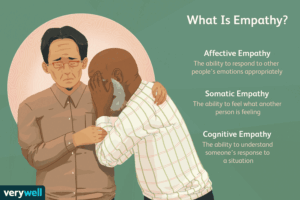




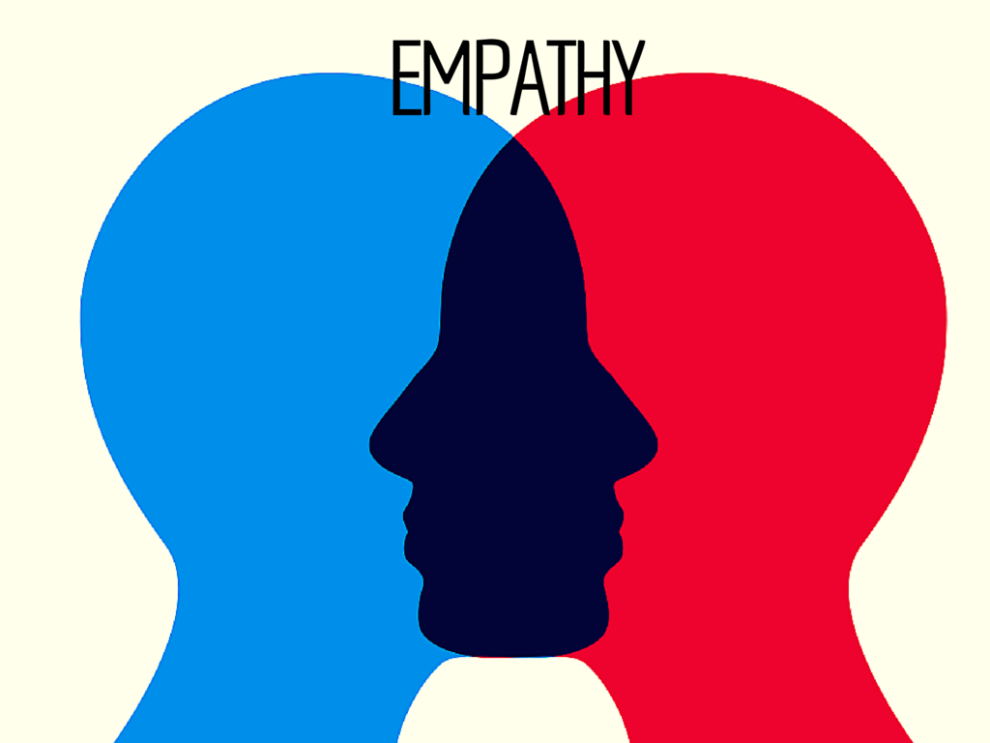


Empathy, in psychology, refers to the capacity to understand and share another person’s emotional state while maintaining awareness that the feeling belongs to the other, not oneself. Unlike emotional contagion (simply “catching” another’s emotion), empathy involves a self-other distinction—the ability to differentiate between one’s own feelings and those of another.
Three core components are widely recognised in psychological literature :
- Affective sharing: Feeling what another person feels (vicarious emotion)
- Cognitive perspective-taking: Understanding another’s mental state intellectually
- Self-regulatory mechanisms: Monitoring the origins of self and other feelings to avoid confusion
Key distinctions from related concepts are essential for a precise understanding. Empathy differs from sympathy, which focuses on alleviating another’s suffering rather than on sharing their experience. It also differs from compassion (concern for another’s welfare) and from the theory of mind (pure cognitive understanding without emotional resonance). A 2025 Delphi study of 43 experts from helping professions defined empathy’s core skills as self-reflection, emotional intelligence (including self-regulation), self-awareness of biases, avoiding judgment, active listening, and helpful action.
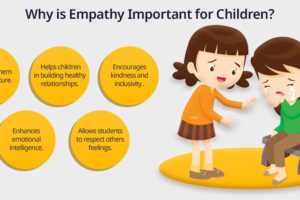
Developmentally, empathy emerges in the second year of life as children develop self-awareness (mirror self-recognition around 18-24 months). Newborns show emotional contagion (crying when others cry), but true empathy requires the capacity to represent the self as distinct from others—a milestone that marks the transition from automatic reactivity to genuine empathic responsiveness. This capacity relies on distinct neural circuits involving the anterior insula, anterior cingulate cortex, and other regions associated with the salience network.