





Empathy is the capacity to understand, share, and respond to the emotional experiences and perspectives of others. It involves stepping outside one’s own frame of reference to enter another’s inner world. As psychologist Carl Rogers described, empathy means “to perceive the internal frame of reference of another with accuracy and with the emotional components which pertain thereto, as if one were the person, but without ever losing the ‘as if’ condition.”
Empathy operates through two distinct but interconnected systems in the brain. Such As,
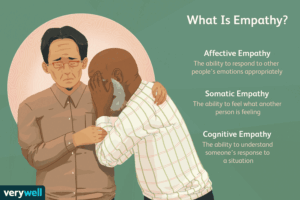
- Cognitive empathy involves the intellectual capacity to understand another’s perspective and mental state.
- Affective empathy enables us to physically and emotionally share what others feel—tearing up at a friend’s sadness, feeling joy when another succeeds.
- A third dimension, compassionate empathy, adds the motivation to act and help when others suffer.
These systems engage different neural networks: cognitive empathy activates the medial prefrontal cortex and temporoparietal junction, while affective empathy engages the anterior insula, amygdala, and anterior cingulate cortex.
What makes empathy fascinating is its dual nature as both a biological capacity and a trainable skill. Mirror neurons provide the neurological foundation, firing both when we experience an emotion and when we observe it in others. Yet empathy can be cultivated through intentional practice—active listening, perspective-taking exercises, loving-kindness meditation, and exposure to diverse experiences through literature and film. Research demonstrates that consistent practice strengthens empathic capacity regardless of age or baseline ability. Empathy also reveals important distinctions: it differs from sympathy, which feels for someone from a distance, while empathy feels with them. Both have value, but only empathy creates the deep connection where people feel truly seen.
Empathy is the fundamental human capacity that bridges separate selves—enabling us to see through another’s eyes, feel with another’s heart, and respond with genuine care, ultimately reminding us that our deepest need is to be truly understood.