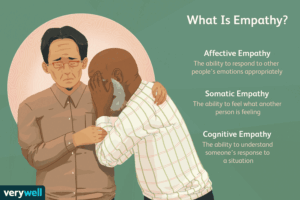






Empathy and relationships are fundamentally intertwined, with empathy serving as the essential mechanism that fosters emotional closeness, sustains social bonds, and enables couples to navigate both daily interactions and stressful situations. It involves the ability to understand a partner’s perspective (cognitive empathy) and share their emotional experience (affective empathy). Research consistently demonstrates that higher empathy is positively associated with relationship satisfaction and constructive communication styles.
The dynamics of empathy in relationships are complex and operate at both individual and dyadic levels. Studies using the Actor-Partner Interdependence Model reveal that one partner’s empathy can influence the other’s experience: for instance, perspective-taking in men improves their female partners’ ability to employ positive coping strategies, while empathic concern in women enhances their male partners’ coping. Empathy also acts as a mediator, with research showing it plays a partial mediating role in the link between relational mindfulness and marital intimacy. Furthermore, a 2025 study on digital communication found that empathic accuracy for a partner’s affective valence (emotional state) was significantly associated with relationship quality.
What makes this relationship particularly compelling is the critical distinction between different forms of empathy. UC Santa Barbara researchers found that simply understanding a partner’s suffering (cognitive empathy) is insufficient to be helpful during stressful situations; one must also genuinely care (affective empathy) . When listeners had accurate knowledge but lacked compassion, they tended to be less supportive. Conversely, distorted perceptions such as hostile attribution bias—the tendency to perceive a partner’s intentions as negative—can undermine empathy, particularly in individuals with histories of childhood trauma. Additionally, believing that emotional resources like empathy are limited (zero-sum beliefs) reduces empathic engagement and heightens sensitivity to perceived imbalances, which predicts increased depressive symptoms.
Empathy in relationships is therefore a dynamic, multidimensional capacity that requires both understanding and caring; it not only enhances intimacy, coping, and satisfaction but also serves as a protective factor against relational distress, with the power to shape how partners perceive, support, and grow with one another over time.